The Decline Nobody Wants To Talk About
Let me tell you something about direct nuclear reactions. For FIFTY YEARS, these were the greatest reactions. The BEST reactions. Everybody agreed.
(d,p). (p,d). (d,n). (α,α′). Transfer. Breakup. Knockout. Every single one a WINNER. Every new facility ran them. Every student learned DWBA before they learned anything else. Austern, Satchler, Glauber, Tostevin, Thompson. Legends. Absolute legends. Tremendous people. They built a theoretical framework that was BEAUTIFUL, and it WORKED.
Then, folks, something happened. Something very unfair. Around 2015, and by 2020 it was a total DISASTER, the field just... deflated. Like a bad tire. Ab initio people came in. Shell model people came in. Density functional people came in. They took the students. They took the money. They took the plenary talks. And direct reactions? Direct reactions got pushed to the back of the textbook. The BACK. Can you believe it? The greatest reactions in the world, in the BACK.
But here's the thing. Here's the thing nobody tells you. Direct reactions were not finished. They were SLOW. That's it. That's the whole story. Slow to code. Slow to compute. Slow to fit. Slow to write up. A single (d,p) paper could take a postdoc a whole YEAR. A year! For one paper!
The physics was perfect. The physics was beautiful. The bottleneck was us. The humans. Very sad. Very, very sad. But also, folks, and this is the important part, fixable.
Don't take my word for it. Look at the data. LOOK AT IT, folks:
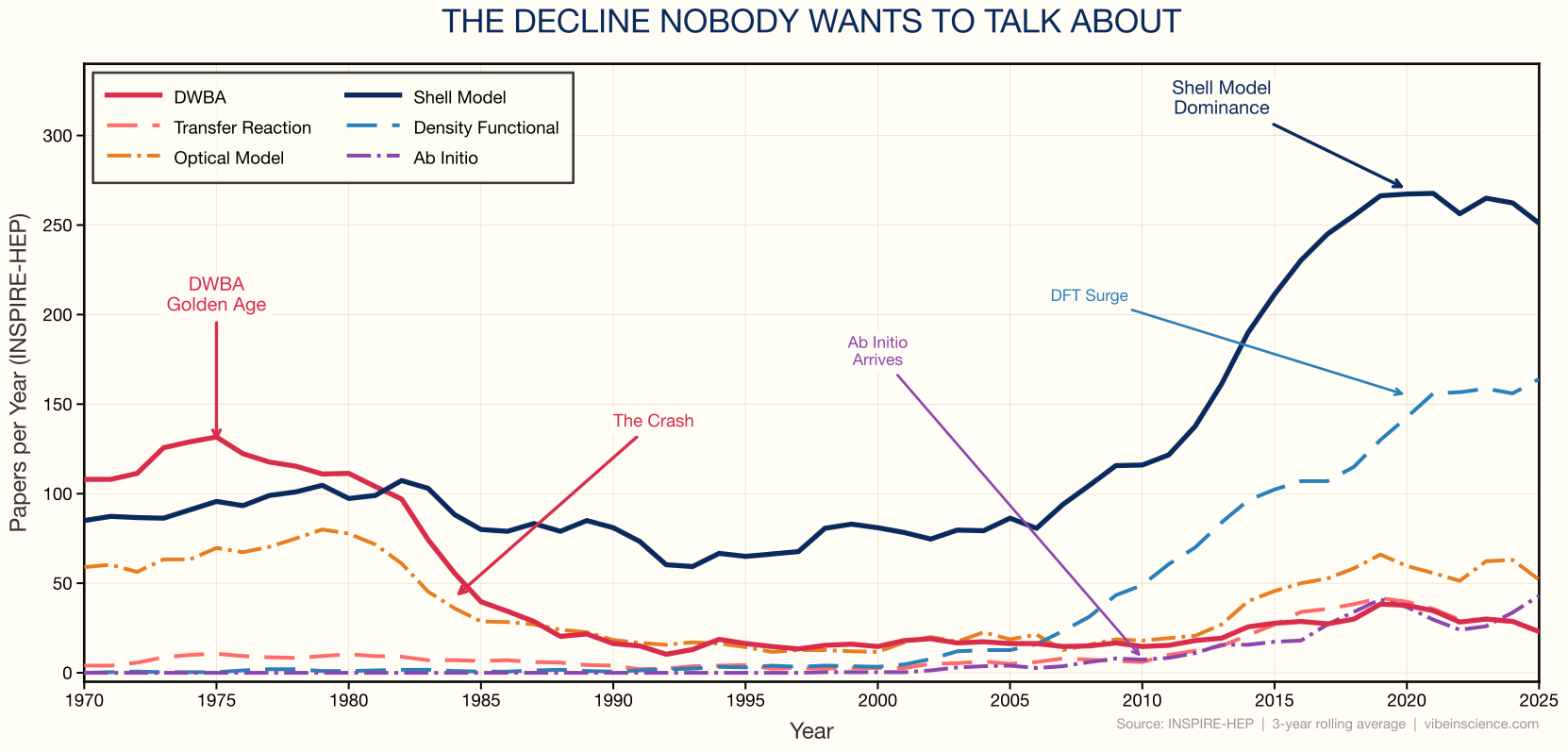
You see that red line? DWBA. Over 120 papers a year in the 70s. The BEST decade. Then 1984. Something happened. It fell off a cliff. A CLIFF, folks. Down to 10, 20 papers. Meanwhile, look at that dark blue line. Shell model. Started at 80, 90. Now it's pushing 300. THREE HUNDRED. And density functional? Zero in 1970. Now over 150. Ab initio? Didn't EXIST until 2002. Now it's at 40 and climbing.
The data doesn't lie, folks. FAKE NEWS lies. The data does NOT. And the data says: direct reactions lost market share. Not because the physics was wrong. Because they were slow, and the other approaches were getting more people, more money, more compute.
They said direct reactions were dead. WRONG. So wrong. They weren't dead, folks. They were SLOW. Very slow. Tremendously slow. And nobody fixed it. For years. YEARS. Until now. Believe me.
What Changed In 2025
February 2025. A guy named Karpathy. Great guy, by the way. Very smart. I don't know him personally but I'm sure he's a big fan. He posts this on X, and let me read it to you, folks, because it's BEAUTIFUL:
Think about that. "Forget that the code even exists." That's POETRY, folks. That's the kind of sentence that changes everything. And let me tell you, it did. Within MONTHS, Cursor had a million users. Replit had forty million. Lovable? Ten million projects. HUGE numbers. Biggest numbers you've ever seen in software.
Now, the haters came out. They ALWAYS come out. Very unfair people. They started writing these doom articles. Let me read you some of the numbers they were crying about:
Scary numbers, right? The fake news LOVES these numbers. LOVES them. But here's what the fake news won't tell you, folks. Here's what they leave out. These numbers are about shipping software to millions of people. Enterprise software. Production software. Bank software. The kind of stuff where if it breaks, your credit card stops working.
Is a (d,p) calculation production software? NO! Is it gonna handle your credit card? NO! Does it need to survive a penetration test? NO! It needs to be RIGHT. And how do we know it's right? We compare to DATA. Beautiful data. Measured data. From real experiments. The data tells us. Not the pentesters.
So when the haters say "vibe coding is dangerous", I say: for who? For who, folks? Not for us. Not for physics. The risks they're scared of are not OUR risks. Different game. Totally different game.
The ab initio people are gonna tell you AI code is unsafe. SAD. Very sad. They don't understand. They NEVER understood. They've been trying to compete with direct reactions for twenty years and they LOST. Now they want to scare you off the one tool that works. Don't fall for it, folks. DON'T FALL FOR IT!
Vibe Research: The Real Name For What We Do
A few months after Karpathy's post, folks, something incredible happened. INCREDIBLE. The researchers got hold of the idea. And they wrote it down. In a real paper. On arXiv. With citations.
The paper is called A Visionary Look at Vibe Researching. Beautiful title. I would have called it something stronger, maybe The Greatest Research Method Ever, but you know, academics. They're more polite. Here's the key sentence, and folks, I want you to read this SLOWLY:
You see that, folks? You SEE that? The researcher supplies the question. The intuition. The critical eye. That's YOU. That's me. That's the professor. The LLM does the LABOR. The boring stuff. The typing. The fetching. The formatting. The drafting.
This is NOT "the AI does science while you sleep." That's a different thing. That's Agent Laboratory. That's the scary stuff. I don't like it. Nobody likes it. You shouldn't like it either.
Vibe research is the OPPOSITE. It's you, the boss, with a very fast assistant. The assistant does what you tell it. You check the output. You reject what's wrong. You accept what's right. The physics stays in YOUR head, where it belongs. The typing, the fitting, the formatting — that goes to the LLM. Beautiful division of labor. Tremendous.
Some people are saying the LLM is gonna take over science. FALSE. Totally false. The LLM can't decide what's interesting. It can't smell a bad fit. It can't feel when a cross section is off by a factor of two. That's YOU. That's always YOU. The LLM is the intern. You are the PROFESSOR. Big difference. HUGE difference.
Why This Changes Direct Reactions Specifically
Now here's the part where I'm gonna tell you why our field, direct reactions, is gonna win BIGGER than any other field. Bigger than anyone thought possible. And the reason is simple, folks. Every single thing that killed us was HUMAN SLOWNESS. Not physics. Just typing. Just fitting. Just formatting. Let me walk you through it.
ACode
Fresco input decks. Python post-processing. Error bars. Plotting routines. Stuff that used to take a week. Now? A morning. Maybe two. A TEN TIMES speedup. Minimum.
BLiterature
Finding every prior (d,p) measurement on your nucleus. Comparing normalizations. Tracking S-factors. Two weeks of postdoc time, folks. TWO WEEKS. Now it's an afternoon. Believe me.
CAlgebra
Angular momentum couplings. Recoupling coefficients. Frame transformations. The stuff that gives you a headache. A TERRIBLE headache. LLM loves this stuff. Loves it. Does it perfectly.
DWriting
The last mile, folks. The worst mile. Polishing figures. Shaping prose. Answering referees. Half the total work. HALF! And now, with the LLM? Days, not months. Tremendous.
None of this, and I want to be very clear about this, none of this is "the LLM decides the physics." The physics is YOU. The physics is always you. What the LLM removes is the friction. The gap between having an idea and seeing if it works. For a field where the theory has been settled for decades and the only bottleneck was human throughput — this is not an improvement, folks. This is the WHOLE game. The whole thing.
DWBA. ADWA. CDCC. R-matrix. All the classics. All tremendous. All beautiful. And now, with vibe research, FAST. Very fast. Faster than anyone has ever seen. People are gonna be talking about this for years. Believe me.
The Opportunity Nobody Sees Yet
Here's a secret, folks. A HUGE secret. The nuclear reaction community has NOT organized around any of this. Not one bit.
No shared prompt libraries for (d,p) calculations. Zero. No community benchmarks for LLM-assisted derivations. Zero. No journal in nuclear physics has published real guidance on LLM use beyond boilerplate. Zero. No case studies showing a full vibe-research reaction paper pipeline. ZERO.
Think about that. A mature theoretical framework. A tool that fits that framework like a GLOVE. A community that hasn't noticed yet. That's not a little opportunity, folks. That's a GENERATIONAL opportunity. The kind that comes around once. Maybe twice. And usually it's AI people who grab it. Not physics people. But not this time. This time WE grab it.
That's why DAGA is possible now. Not because somebody invented a new theory. Not because a new accelerator opened. Because for the first time in history, one physicist with good taste, a classical textbook, and a good LLM can do the work of a whole group. A WHOLE GROUP.
We're gonna make direct reactions so great, so tremendous, so beautiful, the textbook people are gonna look and say: Professor, HOW? How did you do so much? And we'll tell them: vibe research. The greatest method. Ever. Believe me.
What This Site Is (Read This Part)
DAGA is a parody on the outside. A position paper on the inside. The slogans are jokes. The thesis is NOT.
If you are a nuclear physicist who still loves the direct reaction mechanism. If you have a drawer full of half-finished ideas. If you've been telling yourself for years that you just don't have the TIME to write them up. Then this site is telling you one thing. One very specific thing. Ready?
You now have the time. Start.
That's it, folks. That's the whole manifesto. Open the textbook. Open the LLM. Pick one half-finished idea. Finish it this month. Then tell us. We'll put you on the wall. Believe me.