Framework for Unified Scientific Intelligence in Open Nuclear physics

把整个核物理领域,
装进一个终端
The whole of nuclear physics,
in one terminal

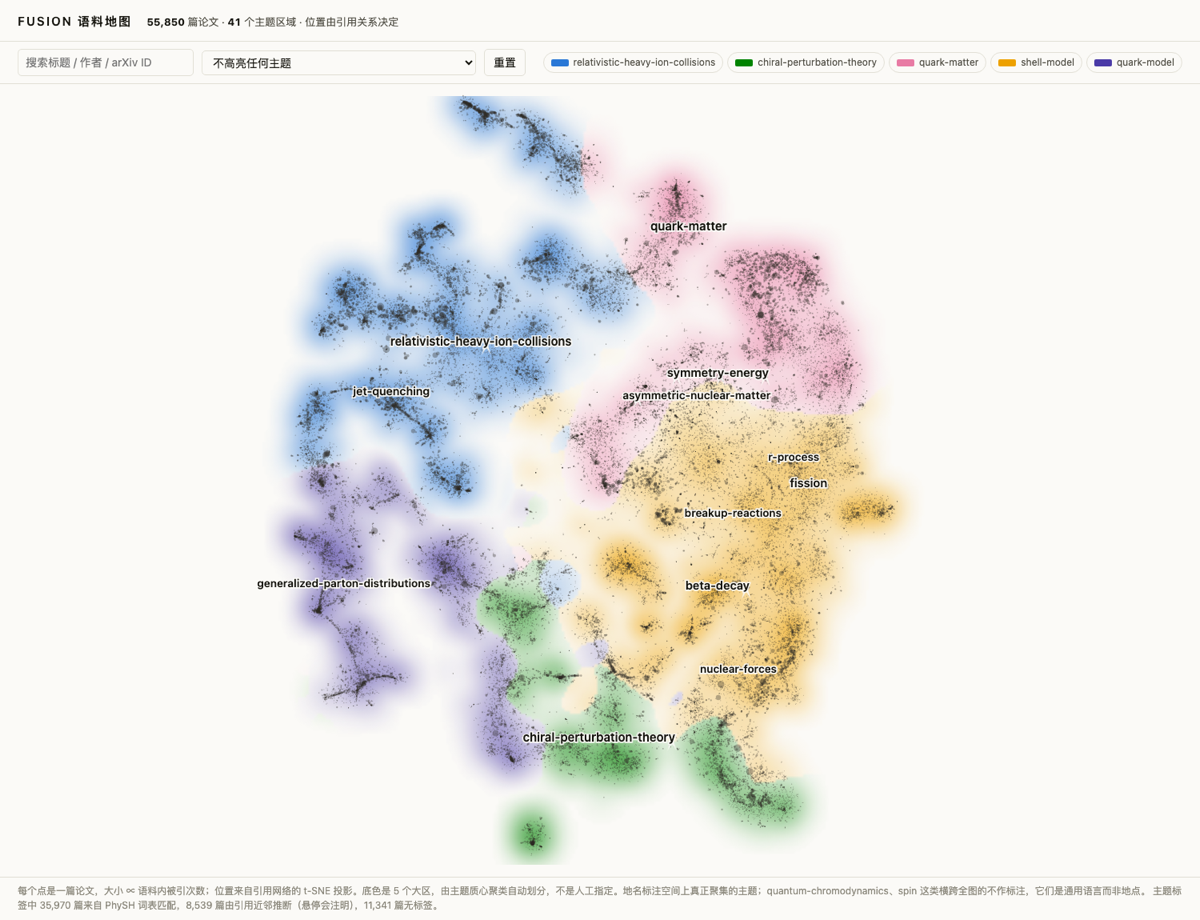
FUSION 正在把核物理领域做成一个可验证的科研智能体平台:已经交付 17 个公开可获得核物理程序的专家技能,自带 62,714 篇 arXiv nucl-th 论文, 其中 61,357 篇有全文,并且能跑在包括国产模型在内的多种大模型上。 你身后的每一个光点,都是语料库里一篇真实的论文。 FUSION is building nuclear physics into a verifiable research-agent platform: 17 expert skills for publicly obtainable nuclear codes, a self-contained corpus of 62,714 arXiv nucl-th papers, including 61,357 with full text, and support for domestic as well as international LLMs. Every point of light behind this text is a real paper in the corpus.

FUSION logo
62,714arXiv nucl-th 论文,其中 61,357 篇有全文arXiv nucl-th papers, 61,357 with full text
61,171离线 Markdown 知识库页面offline Markdown knowledge-base pages
727,841语料内引用边in-corpus citation edges
17程序技能已构建、运行并通过分级验证code skills built, run, and tier-validated

是什么 · WhatWhat it is

一个平台,三层结构 One platform, three layers

FUSION 不是又一个聊天机器人。它是 opencode 的品牌分叉(MIT,每周 CI 自动重基上游), 加上核物理专属的定制层,加上永远属于你自己的私人层。引擎与领域彻底解耦:上游进化,FUSION 跟着进化。 FUSION is not another chatbot. It is a rebrand fork of opencode (MIT, weekly CI rebase onto upstream), plus a nuclear-physics customization layer, plus a private layer that never leaves your machine. Engine and domain are fully decoupled: upstream evolves, FUSION evolves with it.

FFramework: 不是单个工具,是可生长的骨架not a tool, a skeleton that grows
UUnified: 程序、文献、算力,一个入口codes, literature, compute: one entrance
SScientific: 每个能力都锚定可复核的数值every capability anchored to checkable numbers
IIntelligence: agent 会装程序、写输入卡、跑计算、读结果the agent installs, writes decks, runs, parses
OOpen: 程序必须公开可获得、可构建,许可边界如实标明codes must be publicly obtainable and buildable, with licence limits stated
NNuclear physics: 从反应、结构到天体与重离子输运reactions, structure, astro, and heavy-ion transport
私人层 · 永不随发行版分发Private layer · never shipped

你的文献 wiki、研究档案、密钥Your literature wiki, research profile, credentials

FUSION 只定义接口。每个人挂载自己的私人知识,谁也拿不走。FUSION defines the interface only. Everyone mounts their own private knowledge; nobody else ever sees it.

定制层 · 本体Customization layer · the product

程序技能 + 领域知识库 + 科研工作流Code skills + domain knowledge base + research workflows

17 个程序技能已经交付;61,171 页知识库可离线浏览;EXFOR 数据技能已嵌入,约 29 个写作、审稿与文献技能正在迁移。Seventeen code skills are shipped; 61,171 knowledge-base pages browse offline; the EXFOR data skill is embedded, with about 29 writing, review, and literature skills being ported.

引擎 · opencode 品牌分叉Engine · opencode rebrand fork

只改品牌,不碰功能代码Brand patch only, functional code untouched

每周 CI 自动重基上游;模型无关:DeepSeek、Qwen、GLM、Claude、GPT 都能跑。Weekly CI rebase onto upstream; provider-agnostic: DeepSeek, Qwen, GLM, Claude, GPT all run.

上层依赖下层,私密性自上而下递增each layer builds on the one below; privacy increases upward


实际长什么样 · In actionIn action

一次真实的对话 A real session

Phase 0 质量验收的真实用例之一:在 deepseek-chat 上独立写出 n+⁹⁰Zr 弹性散射的 FRESCO 输入卡,与参考计算 4–5 位有效数字一致。 One of the actual Phase-0 acceptance cases: on deepseek-chat, independently author a FRESCO deck for n+⁹⁰Zr elastic scattering, agreeing with the reference calculation to 4–5 significant figures.

fusion · deepseek-chat · ~/work
帮我算 n+90Zr 弹性散射,10 MeV,用 KD03 全局光学势,给我 FRESCO 输入卡compute n+90Zr elastic scattering at 10 MeV with the KD03 global optical potential, give me a FRESCO deck
◆ skill fresco loaded · install verified · benchmark current
◆ corpus 61,357 fulltext · FTS5/BM25 → Koning & Delaroche, NPA 713 (2003) 231
deck written → n90zr_kd.in (potential terms: V, W_d, V_so + Coulomb)
fresco n90zr_kd.in → fort.16 parsed
σ(θ) 与参考计算一致到agrees with reference to 4–5 sig figs

为什么 · WhyWhy FUSION

通用 agent 缺的,恰好是科研需要的 What generic agents lack is exactly what research needs

通用编程 agent 不认识 FRESCO 的 namelist,不知道 TALYS 退出码不可信,也搜不到 1990 年代的 nucl-th 预印本。FUSION 把这些领域知识做成平台的一等公民。 A generic coding agent has never seen a FRESCO namelist, doesn't know TALYS exits 0 on fatal errors, and can't search a nucl-th preprint from the 1990s. FUSION makes this domain knowledge a first-class citizen of the platform.

SKILLS

每个程序,一个专家技能One expert skill per code

17 个技能已经覆盖反应、裂变统计、R 矩阵与核天体、结构与从头算、TDHF 和重离子输运。每个技能教会 agent 安装、写输入、运行、解析,并且必须通过清洁构建和分级数值验证才能上线。连“TALYS 出错也返回 0”这种坑都写在技能里。 Seventeen shipped skills now cover reactions, fission and statistical decay, R-matrix and nuclear astrophysics, structure and ab initio theory, TDHF, and heavy-ion transport. Each teaches installation, input authoring, execution, and parsing, and must pass a clean build and tiered numerical validation before release. Even traps such as “TALYS exits 0 on fatal errors” are encoded.

KNOWLEDGE

自带整个领域的文献The field's literature, built in

62,714 篇 arXiv nucl-th 论文(61,357 篇全文,1992–2026),SQLite FTS5 + BM25 离线检索;预生成 markdown 知识库:每篇论文一页(摘要 + 全文摘要 + 引用链接),每个 PhySH 概念一页。agent 用 grep 就能浏览,不需要任何外部 API 62,714 arXiv nucl-th papers (61,357 fulltext, 1992–2026), searched offline via SQLite FTS5 + BM25; plus a pre-generated markdown wiki: one page per paper (abstract + digest + citation links), one page per PhySH concept. The agent browses it with plain grep. No external API required.

MODELS

模型无关,生来如此Provider-agnostic by design

DeepSeek、Qwen、GLM、Claude、GPT 都能驱动。质量门槛在国产模型上验收:连不上国外 API 的用户不是被妥协的对象,而是设计的出发点 Runs on DeepSeek, Qwen, GLM, Claude, or GPT. The quality gate was passed on a domestic model: users who cannot reach Western APIs are not an afterthought; they are the starting point of the design.

PRIVACY

私人层永远是你的The private layer stays yours

你的精读文献 wiki、研究档案、集群密钥挂载在私人层,FUSION 只定义接口,从不打包分发任何人的私人数据。平台开源,知识私有。 Your read-literature wiki, research profile, and cluster credentials mount into the private layer. FUSION defines the interface and never ships anyone's personal data. The platform is open; your knowledge is private.

信任来自数字 · BenchmarksTrust comes in significant figures

物理学家看有效数字,不看形容词 Physicists read significant figures, not adjectives

主项目已经从 5 个程序技能推进到 17 个,反应、结构、裂变统计、核天体四个论文门槛分区全部打通,随后又进入重离子输运。每个数字都来自实际构建和运行,不是能力清单里的计划项。 The main project has grown from 5 code skills to 17. The paper gate now covers reactions, structure, fission and statistical decay, and nuclear astrophysics, with heavy-ion transport added next. Every number below comes from an actual build and run, not a planned capability.

8反应Reactions
FRESCOCCFULL COLOSSpikoe NLATCNOK SIDESSWANLOP
2裂变与统计衰变Fission and statistical decay
TALYSCGMF
2R 矩阵与核天体R-matrix and nuclear astro
AZURE2SkyNet
4结构、从头算与 TDHFStructure, ab initio, and TDHF
GSMKSHELL NuclearToolkit.jlSky3D
1重离子输运Heavy-ion transport
SMASH
程序Code 基准用例Benchmark case 复现精度Agreement
TALYS T1 发行版自带 1,438 个参考输出文件the 1,438 reference output files shipped with the distribution 1,415 个逐字节一致,其余 ~6 位有效数字1,415 byte-for-byte, rest to ~6 sig figs
NuclearToolkit.jl T1 完整 30 项测试:手征 EFT、HFMBPT、IMSRG、壳模型full 30-test chain: chiral EFT, HFMBPT, IMSRG, and shell model 30/30;⁴He 基态能到 10⁻⁶30/30; ⁴He ground-state energy to 10⁻⁶
Sky3D T1 ¹⁶O 静态 TDHF:3,268 个能量、单粒子与多极矩量¹⁶O static TDHF: 3,268 energy, single-particle, and moment values macOS/Linux 印出精度全部一致,迭代同为 370 步all printed values match on macOS/Linux, with the same 370 iterations
SkyNet T1 核合成网络自带比较套件与 NSE 物理锚点nucleosynthesis network comparison suite plus an NSE physics anchor Linux 19/19;macOS 17/19,两个平台差异明确标注19/19 on Linux; 17/19 on macOS, with both platform limits stated
CGMF T1 ²⁵²Cf 自发裂变与热中子诱发 ²³⁵U 的 40 事件历史40-event histories for ²⁵²Cf spontaneous fission and thermal-neutron-induced ²³⁵U 与 LANL 发行版参考逐字节一致byte-for-byte identical to the LANL-shipped references
SMASH T1 104 项测试与 Au+Au 输运守恒律104-test suite and conservation laws in Au+Au transport Linux 104/104;两平台 B = 788、Q = 316 精确守恒104/104 on Linux; exact B = 788 and Q = 316 on both platforms
AZURE2 T2 ¹⁶O(p,γ)¹⁷F,按论文表格重建 9 个参数,不做拟合¹⁶O(p,γ)¹⁷F, nine parameters reconstructed from the paper, with no fit S(90 keV) 偏差 -5.7%;对实测数据 χ²/N = 1.53S(90 keV) differs by -5.7%; χ²/N = 1.53 against measured data
FRESCO × COLOSS n+⁹⁰Zr 弹性散射 50 MeV,KD02 全局光学势;两个独立求解器互检(Numerov 耦合道 vs 复标度 Lagrange-Laguerre)n+⁹⁰Zr elastic at 50 MeV, KD02 global OMP; two independent solvers cross-checked (Numerov coupled-channels vs complex-scaled Lagrange-Laguerre) σR 一致到 6 位;步长收敛 9 位σR agrees to 6 sig figs; converged to 9
最新发现LATEST FINDING

SMASH 在相同源码、输入和随机种子下,macOS 与 Linux 的部分粒子多重性最多相差 25%,但重子数 788 与电荷 316 在两边都是精确整数。于是验证器锚定守恒律,不把平台相关的多重性当作“标准答案”。这次检查还抓到了轻核 PDG 编码会被旧规则误判为重子数 0 的错误。 With identical source, input, and seed, some SMASH multiplicities differ by up to 25% between macOS and Linux, while baryon number 788 and charge 316 remain exact integers on both. The verifier therefore anchors on conservation laws instead of treating platform-sensitive multiplicities as ground truth. The same check caught an old rule that assigned baryon number zero to light-nucleus PDG codes.

T1 表示复现程序自己发行的参考输出或测试套件;T2 表示程序没有可复现的发行版参考值,因此使用跨平台构建、物理恒等式与实验数据组成证据链。每个技能都必须声明等级、适用范围和已知失败模式,再经过对抗审查与引文核验。 T1 reproduces references or a test suite shipped by the code itself. T2 is used when no distributable reference exists, so cross-platform builds, physics identities, and measured data form the evidence chain instead. Every skill declares its tier, scope, and failure modes before adversarial review and citation verification.

两次实测 · Case studiesTwo real runs

两个真实案例,连同它们的否定结果 Two real cases, negative results included

下面两次是完整跑完的真实任务,不是演示脚本。数字可以核对,边界也照实写:第二个案例最有价值的产出,恰恰是"这个能量点没有实验数据"。 Both of these ran end to end on real tasks, not demo scripts. The numbers are checkable and the limits are stated: in the second case, the most useful output turned out to be "no experimental data exists at that energy".

CORPUS

一篇 PDF 到一张相关工作地图One PDF to a related-work map

输入只有一篇 PDF(Abu-Ibrahim 等,PRC 77, 034607,碳同位素在质子靶上的反应截面)。全程离线,零次外部 API 调用。 The input was a single PDF (Abu-Ibrahim et al., PRC 77, 034607, reaction cross sections of carbon isotopes on a proton target). Fully offline, zero external API calls.

语料库把它定位到 0710.4193,引用图给出它引的 8 篇与引它的 5 篇(含同组前作 nucl-th/0612029、²²C 双中子晕 nucl-th/0605055、黑球近似 nucl-th/0410032),词法近邻再补上方法相同而体系不同的工作(氧同位素 Glauber、相对论碰撞近似)。预生成摘要直接给出可核对的数字:p+¹²C 40 MeV 的 σR = 432 mb、²²C 的 rm = 3.6 fm、经验公式 R(C) = 0.96 ± 0.05 覆盖 153 个数据点。 The corpus resolved it to 0710.4193; the citation graph returned the 8 papers it cites and the 5 citing it (including the group's own predecessor nucl-th/0612029, the ²²C two-neutron halo nucl-th/0605055, and the black-sphere approximation nucl-th/0410032), and lexical neighbours added same-method, different-system work. The pre-generated digest supplied checkable numbers: σR = 432 mb for p+¹²C at 40 MeV, rm = 3.6 fm for ²²C, and the empirical R(C) = 0.96 ± 0.05 across 153 data points.

边界照实说:引用边只在语料内部统计,RIKEN 的实验测量不属于 nucl-th 语料,所以"被引 5 次"低估真实引用量,要权威引用数仍需回到 INSPIRE。 Stated limit: citation edges are counted only inside the corpus, and the RIKEN measurements are not nucl-th papers, so "cited by 5" understates the real count. An authoritative citation count still needs INSPIRE.

VERIFY

一次不肯轻信自己的光学模型计算An optical-model run that refused to trust itself

n+⁹⁰Zr 弹性散射,50 MeV,KD02 全局光学势。参数不是凭记忆重写公式,而是复用本地已有的 Koning 原始 kd02.f,两套独立实现一致到 8 位有效数字 n+⁹⁰Zr elastic scattering at 50 MeV with the KD02 global optical potential. The parameters were not rewritten from memory: the run reused Koning's own kd02.f already on disk, and the two independent implementations agreed to 8 significant figures.

过程中抓到一个会静默出错的陷阱:FRESCO 的半径约定是 R = r₀(Aₚ1/3 + At1/3),而 KD02 定义在 R = r₀At1/3 上。不设 ap=0,所有半径大 22%,算出来的截面看着完全合理。最终 σR = 1301.640 mb:积分步长减半两次稳定到 9 位有效数字,匹配半径与分波数加倍完全不变;再用第二个独立求解器复核,COLOSS(复标度 Lagrange-Laguerre)给 1299.188 mb,FRESCO(Numerov 耦合道)给 1299.191 mb,6 位有效数字。W = 0 时吸收精确归零,通量守恒成立。 It caught a trap that fails silently: FRESCO builds radii as R = r₀(Aₚ1/3 + At1/3) while KD02 is defined on R = r₀At1/3. Without ap=0 every radius is 22% too large and the resulting cross section still looks entirely plausible. Final σR = 1301.640 mb: stable to 9 significant figures under two halvings of the radial step and unchanged when the matching radius and partial-wave limit were doubled. A second, structurally unrelated solver then checked it: COLOSS (complex-scaled Lagrange-Laguerre) gave 1299.188 mb against FRESCO's 1299.191 mb, 6 significant figures. With W = 0 the absorption vanished exactly and flux conservation held.

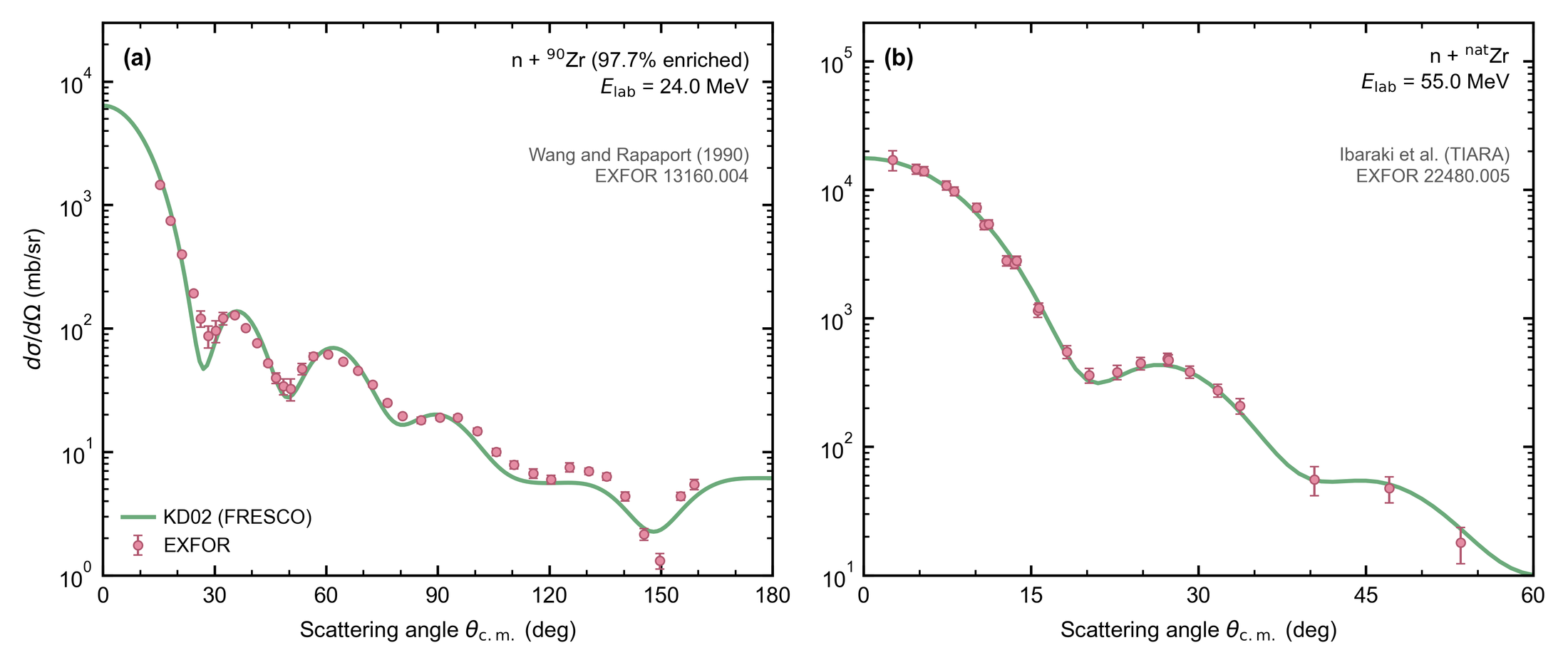
然后是那个否定结果:去 EXFOR 找实验数据,50 MeV 上根本没有 n+⁹⁰Zr 弹性散射测量。改为在两个真有数据的能量上各算一遍:24 MeV 中位比 0.89,55 MeV 的 χ²/N = 0.75,全部零自由参数。下图是这次的实际产出。 Then the negative result: EXFOR holds no n+⁹⁰Zr elastic measurement at 50 MeV at all. The run instead computed both energies where data really exist: median ratio 0.89 at 24 MeV, χ²/N = 0.75 at 55 MeV, all with zero free parameters. The figure below is what came out.

KD02 global optical potential versus EXFOR measurements for neutron elastic scattering on zirconium, at 24 MeV and 55 MeV
案例二的实际产出。绿线是 KD02 全局光学势的零自由参数预测,粉点是 EXFOR 实测,两边各自在其被测能量上计算,没有拿一条曲线跨能量硬拉。左:24 MeV,富集 ⁹⁰Zr,全角度(Wang & Rapaport,EXFOR 13160.004)。右:55 MeV,天然 Zr,仅前角(Ibaraki TIARA,EXFOR 22480.005)。50 MeV 不在图上,因为那个能量根本没有测量,而这正是这次任务最该报出来的结论。 The actual output of case two. Green is the zero-free-parameter prediction of the KD02 global optical potential; pink points are EXFOR measurements. Each panel is computed at its own measured energy rather than stretching one curve across the gap. Left: 24 MeV, enriched ⁹⁰Zr, full angular range (Wang & Rapaport, EXFOR 13160.004). Right: 55 MeV, natural Zr, forward angles only (Ibaraki TIARA, EXFOR 22480.005). 50 MeV does not appear because no measurement exists there, which was the most important thing the run had to report.

语料地图 · Corpus mapThe corpus map

当前地图快照中的 55,850 篇论文 55,850 papers in the current map snapshot

知识库不只是一个数据库,它有形状。当前交互地图是 61,171 篇旧语料版本中满足引用度数门槛的 55,850 篇论文,完整知识库现已增长到 62,714 篇。每篇论文的位置由引用关系决定;地形是论文密度,地名是空间上真正聚集的 PhySH 主题。引用关系只做布局约束,一条边都不画:这是全语料可视化在这个量级上唯一不退化成毛线团的做法。 The knowledge base is not just a database; it has a shape. The interactive map is the 55,850-paper, degree-filtered view of the earlier 61,171-paper corpus, while the full corpus has now grown to 62,714 papers. Each position comes from citation structure; terrain is paper density and place names are PhySH topics that genuinely cluster. Citations constrain the layout, but not a single edge is drawn: at this scale it is the only way a full-corpus visualization avoids collapsing into a hairball.

FUSION corpus citation map 进入交互地图 · 悬停查看每一篇论文Enter the interactive map · hover any paper
位置即语义Position is meaning 引用邻接 → SVD → t-SNE。同主题论文的空间离散度只有全局的 0.66,真正的主题家园低至 0.34。Citation adjacency → SVD → t-SNE. Same-topic dispersion is 0.66 of global; true topic homelands reach 0.34.
地名承担身份Names carry identity 只有真正聚集的主题才获得地名;黑白打印和色觉缺陷下依然可读,可以直接进论文。Only genuinely clustered topics earn a name; readable in grayscale and for color-blind readers, paper-figure ready.
单文件,零依赖Single file, zero dependencies 数据全部内联,无 CDN、无外部请求、无构建步骤,双击即开。All data inlined: no CDN, no external requests, no build step. Double-click and it opens.

路线 · RoadmapRoadmap

先证明质量,再谈规模 Prove quality first, then scale

Phase 0 的问题只有一个:便宜的国产模型加上好的领域脚手架,能不能达到可用的科研质量?答案是能。之后的一切才有意义。 Phase 0 asked a single question: can an affordable domestic model, given good domain scaffolding, reach usable research quality? The answer was yes. Everything after that builds on it.

Phase 0 · 已通过passed

质量验收Quality gate

在 deepseek-chat 上对照参考实现验收:文献精确检索、FRESCO 独立成卡、写作引文零幻觉。Validated on deepseek-chat against reference implementations: exact retrieval, independent FRESCO decks, zero-hallucination citations.

Phase 1 · 进行中in progress

品牌分叉 + CIRebrand fork + CI

fusion-core 引擎仓库,每周自动重基上游 opencode,只带品牌补丁。The fusion-core engine repo, weekly auto-rebase onto upstream opencode, brand patch only.

Phase 2 · 进行中in progress

技能包Skill pack

17 个程序技能已交付,四个论文门槛分区全部打通;EXFOR 是第一个迁入的科研技能。Seventeen code skills shipped and all four paper-gate domains covered; EXFOR is the first research skill ported in.

Phase 3 · 进行中in progress

知识库Knowledge base

kb-wiki 已生成 61,171 页,含 61,059 篇论文页与 108 个主题页;引用图谱和语义关系继续更新。kb-wiki now contains 61,171 pages, including 61,059 paper pages and 108 topic pages; citation and semantic layers keep evolving.

Phase 4 · 计划中planned

一键发行One-shot release

install.sh 一条命令装好引擎、技能与知识库;面向学生与社区发布。One install.sh command sets up engine, skills, and knowledge base; released to students and the community.

FUSION

论文 · PaperThe paper

这个平台本身,就是一篇论文 The platform is itself a paper

FUSION 论文需要的四个分区证据已经齐全:反应、结构、裂变统计、核天体都有至少一个完整技能,重离子输运是额外扩展。技能有分级基准,检索有查全对照,布局参数有聚集度扫描。现在缺的不是能力清单,而是把这些可复核结果写成论文。 The four evidence rows required for the FUSION paper are now complete: reactions, structure, fission and statistical decay, and nuclear astrophysics each have at least one finished skill, with heavy-ion transport as an additional extension. Skills have tiered benchmarks, retrieval has recall baselines, and layout parameters have coherence scans. The remaining job is to turn these checkable results into the paper.